After we created in part 1 all tables and objects, we can now create a new BAdI to generate the partitions. Go to
the transaction se19 and create a new implementation with the Name RSLPO_BADI_PARTITIONING.

Give the enhancement implementation a name and a short text.

Click continue and save. Now specify the BAdI implementation name, the implementation class and the BAdI
definition. Select for the BAdI Definition RSLPO_BADI_PARTITIONING, click continue and save.
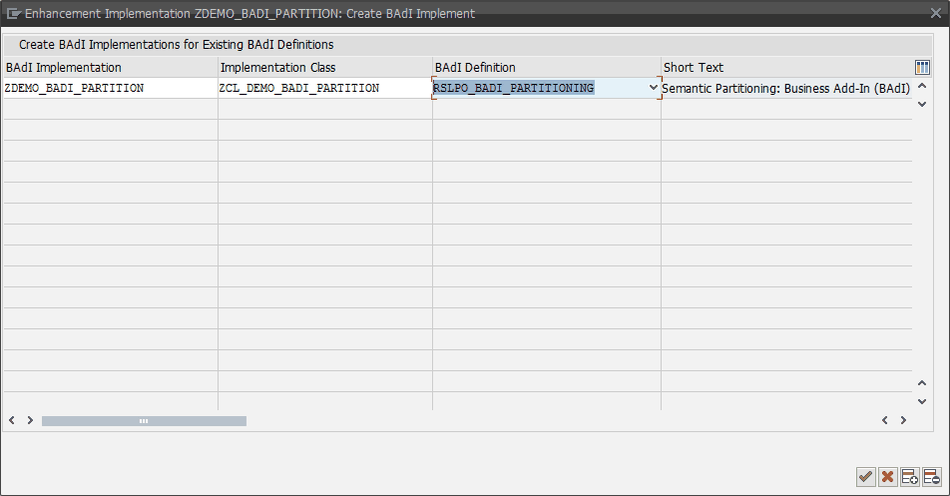
After that the following screen appears.
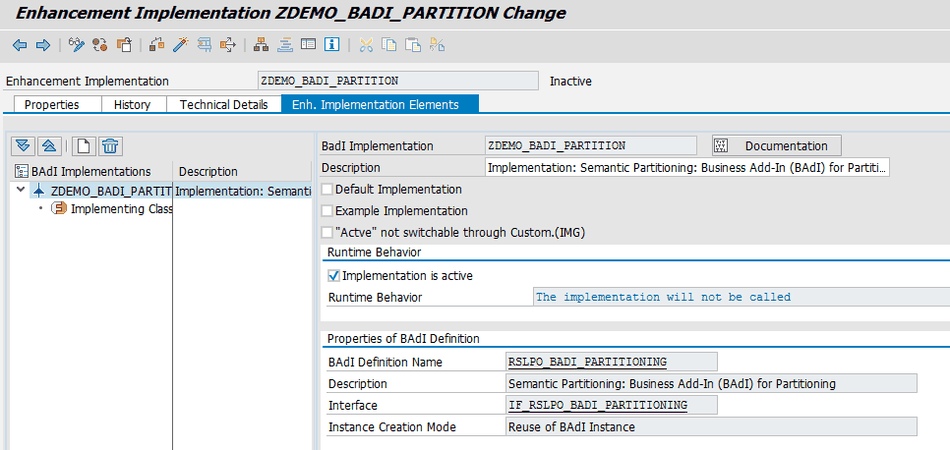
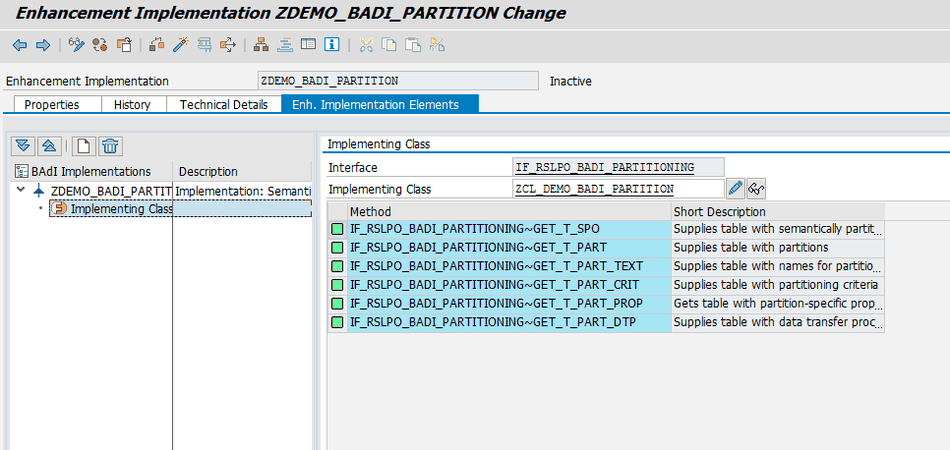
Double click the implementation class and the following screen appears. The 6 methods of the class ZCL_DEMO_BADI_PARTITION which we use to define the partitions are displayed in the right panel.
- GET_T_SPO
- GET_T_PART
- GET_T_PART_TEXT
- GET_T_PART_CRIT
- GET_T_PART_PROP
- GET_T_PART_DTP
Each method has a specific role, which you can see under the short description. Double click the method IF_RSLPO_BADI_PARTITIONING~GET_T_SPO.
First we have to implement the name of the Semantic Partitioning Object (SPO).
1 2 3 4 5 6 7 8 |
method IF_RSLPO_BADI_PARTITIONING~GET_T_SPO. DATA: l_spo TYPE rslponame. "Return a table with names of supported BAdI SPOs. SELECT SPONAME from ZSPOINFOPROV into l_spo. APPEND l_spo TO r_t_spo. ENDSELECT. endmethod. |
Save and activate the method and the class. Now implement the
1 2 3 4 5 6 7 8 9 10 11 12 13 14 15 16 17 18 19 20 21 22 23 24 25 |
method IF_RSLPO_BADI_PARTITIONING~GET_T_PART. DATA: l_cnt TYPE i, l_posit TYPE i VALUE 1, l_id TYPE c LENGTH 2, l_s_part TYPE rslpo_badi_s_part, "ZSPOINFOPROV Variable l_it_spoinfoprov TYPE TABLE OF ZSPOINFOPROV, l_wa_spoinfoprov TYPE ZSPOINFOPROV. SELECT * from ZSPOINFOPROV into CORRESPONDING FIELDS OF TABLE L_IT_SPOINFOPROV where SPONAME = I_SPO. Loop at L_IT_SPOINFOPROV into L_WA_SPOINFOPROV. SELECT COUNT(*) from zspocriteria into l_cnt where PATTERNID = L_WA_SPOINFOPROV-PATTERNID1. WHILE l_posit LE l_cnt. UNPACK l_posit to l_id. l_s_part-IDPART = l_id. l_s_part-POSIT = l_posit. APPEND l_s_part TO r_t_part. l_posit = l_posit + 1. ENDWHILE. CLEAR l_posit. ENDLOOP. endmethod. |
IF_RSLPO_BADI_PARTITIONING~GET_T_PART_TEXT specifies the text for each partition. The problem is, the customer normally named the partitions after his own mind, so I just
implemented a comment, so it would be initialized. The comment is necessary.
1 |
"Coding will follow later
|
Now we implement the IF_RSLPO_BADI_PARTITIONING~GET_T_PART_CRIT. This implementation specifies the partition criteria.
1 2 3 4 5 6 7 8 9 10 11 12 13 14 15 16 17 18 19 20 21 22 23 24 25 26 27 28 29 30 31 32 33 34 |
method IF_RSLPO_BADI_PARTITIONING~GET_T_PART_CRIT. DATA: l_id TYPE c length 2, l_s_part_crit TYPE rslpo_badi_s_part_crit, "SPOCRITERIA Variable l_it_criteria TYPE TABLE OF ZSPOCRITERIA, l_wa_criteria TYPE ZSPOCRITERIA, "ZSPOINFOPROV Variable l_it_spoinfoprov type table of zspoinfoprov, l_wa_spoinfoprov type zspoinfoprov. SELECT * from ZSPOINFOPROV into CORRESPONDING FIELDS OF TABLE L_IT_SPOINFOPROV where SPONAME = I_SPO. Loop at L_IT_SPOINFOPROV into L_WA_SPOINFOPROV. SELECT * from ZSPOCRITERIA into CORRESPONDING FIELDS OF TABLE l_it_criteria where patternid = L_WA_SPOINFOPROV-PATTERNID1 or patternid = l_wa_spoinfoprov-patternid2 or patternid = l_wa_spoinfoprov-patternid3 or patternid = l_wa_spoinfoprov-patternid4. LOOP AT l_it_criteria INTO l_wa_criteria. SELECT INFOOBJECT FROM ZSPOPATTERN into l_s_part_crit-IOBJNM where patternid = l_wa_criteria-patternid. If L_WA_CRITERIA-HIGHVALUE NE ''. l_s_part_crit-opt = 'BT'. ELSE. l_s_part_crit-opt = 'EQ'. ENDIF. UNPACK L_WA_CRITERIA-PARTGROUP to l_id. l_s_part_crit-IDPART = l_id. l_s_part_crit-low = l_wa_criteria-LOWVALUE. l_s_part_crit-high = l_wa_criteria-HIGHVALUE. l_s_part_crit-posit = L_WA_CRITERIA-PARTGROUP. APPEND l_s_part_crit TO r_t_part_crit. ENDSELECT. ENDLOOP. ENDLOOP. endmethod. |
The method IF_RSLPO_BADI_PARTITIONING~GET_T_PART_PROP will only be initialized with the following code:
1 |
"Coding will follow later
|
The next and last method is IF_RSLPO_BADI_PARTITIONING~GET_T_PART_DTP. It specifies the template of the DTP.
1 2 3 4 5 6 7 8 9 10 11 12 13 14 15 16 17 18 19 20 21 22 23 24 25 26 27 28 29 30 31 32 33 34 35 |
method IF_RSLPO_BADI_PARTITIONING~GET_T_PART_DTP. DATA: l_posit TYPE i VALUE 1, l_cnt TYPE i, l_id TYPE c LENGTH 2, l_s_part_dtp type rslpo_badi_s_part_dtp, "ZSPODTP Variable l_it_dtp type table of zspodtp, l_wa_dtp type zspodtp, "ZSPOINFOPROV Variable l_it_spoinfoprov type table of zspoinfoprov, l_wa_spoinfoprov type zspoinfoprov. SELECT * from ZSPOINFOPROV into CORRESPONDING FIELDS OF TABLE L_IT_SPOINFOPROV where SPONAME = I_SPO. Loop at L_IT_SPOINFOPROV into L_WA_SPOINFOPROV. SELECT COUNT(*) FROM ZSPOCRITERIA into l_cnt where PATTERNID = L_WA_SPOINFOPROV-PATTERNID1. SELECT * from ZSPODTP into CORRESPONDING FIELDS OF TABLE l_it_dtp where SPONAME = I_SPO. LOOP at l_it_dtp into l_wa_dtp. l_s_part_dtp-DTPTEMPLATE = l_wa_dtp-DTPTEMPLATE. l_s_part_dtp-OBJNM = l_wa_dtp-OBJNAME. l_s_part_dtp-LOGSYS = l_wa_dtp-LOGSYS. l_s_part_dtp-TLOGO = l_wa_dtp-OBJTYPE. WHILE l_posit LE l_cnt. UNPACK l_posit to l_id. l_s_part_dtp-IDPART = l_id. APPEND l_s_part_dtp TO r_t_part_dtp. l_posit = l_posit + 1 . ENDWHILE. ENDLOOP. ENDLOOP. endmethod. |
After all methods are implemented, activate the Enhancement Implementation. Now we are able to create a Semantic Partitioning Object (SPO). What we need to maintain will be described in Part 3 of this series.
These posts might also be interesting:
author.
I am Tobias, I write this blog since 2014, you can find me on twitter and youtube. If you want you can leave me a paypal coffee donation. You can also contact me directly if you want.
Schreibe einen Kommentar